


 ENG
ENG
The McNAIR Center for Aerospace Innovation and Research at the University of South Carolina’s Molinaroli College of Engineering and Computing has announced the installation and immediate availability of a Mikrosam Libra Multifunctional Robotic System at its 42,000-square-foot advanced manufacturing facility in Columbia, South Carolina. Procurement of this new equipment was made possible through Office of the Secretary of War Manufacturing Technology Program funding with program management support provided by Naval Surface Warfare Center Crane.
The McNAIR Center serves as a multidisciplinary hub for advanced engineering and manufacturing, supporting aerospace, mechanical, electrical, chemical, industrial and biomedical engineering initiatives. The facility enables service work, applied research, technology demonstrations and workforce development in partnership with industry and government stakeholders.
In collaboration with Composite Automation and Mikrosam (Prilep, North Macedonia), the McNAIR Center has installed an 8-tow, ¼-inch Automated Fiber Placement (AFP) head equipped with laser and infrared (IR) heating, integrated onto a KUKA Titan L750 robot mounted on a 35-foot (10.6m) linear rail. The system includes 3.9ft x 3.9ft (1.2 x 1.2m) flat oil-heated tooling as well as headstock and tailstock configurations capable of accommodating tooling up to 14 feet (4.3m) in length and 6 feet (1.8m) in diameter.
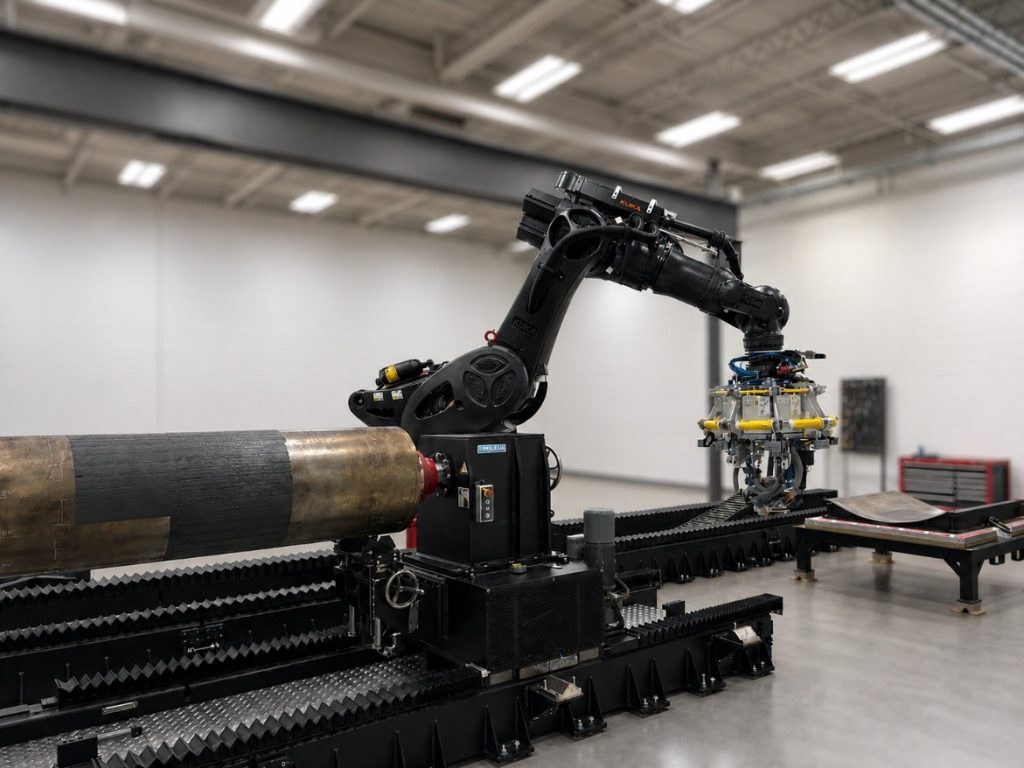
Adaptability and Platform Flexibility
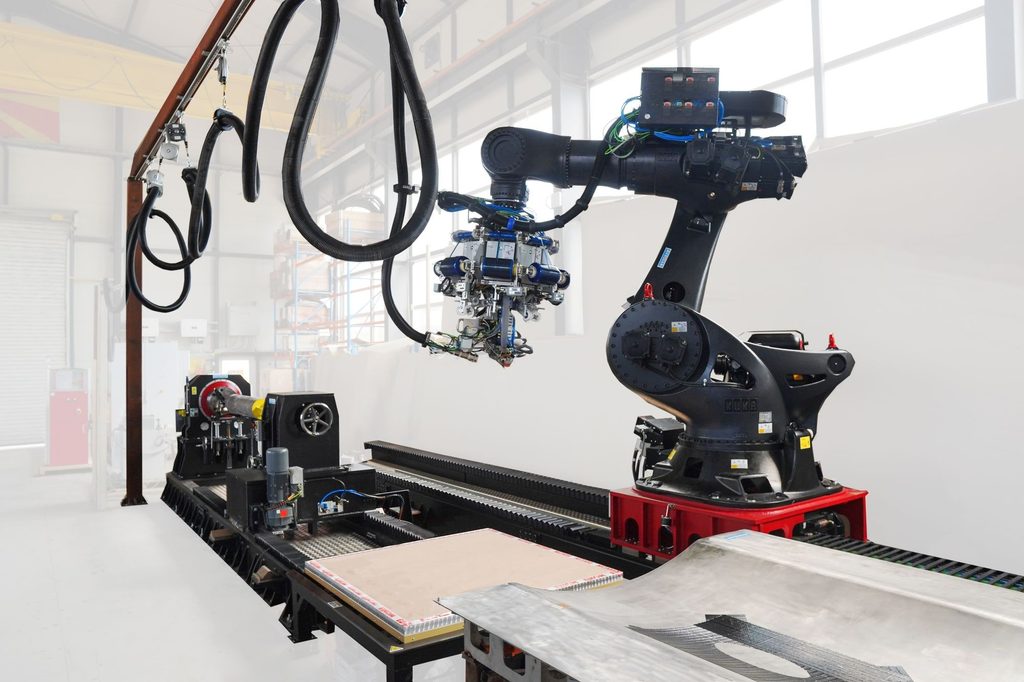
While the system features state-of-the-art AFP head technology, advanced controls and large-format capability, what makes it uniquely powerful is its adaptability. The Mikrosam design allows any end-effector to be placed and controlled from the system, allowing McNAIR Center and its partners to utilize the software and machine for other and novel applications.
In addition to AFP heads, the system can integrate mixed-supplier or in-house developed end-effectors for applications such as thermoplastic welding, automated inspection and other advanced manufacturing processes. This flexibility makes the platform one of the most versatile robotic composite manufacturing systems of its kind.
Multi-Material Capability
The system is fully capable of processing high temperature thermoplastics and equally mature for thermoset materials and dry fiber preforms. McNAIR is also interested in using this equipment to test novel material systems that are not yet used with AFP.
At the core of this capability is Mikrosam’s multi-material AFP head, which enables precise placement of multiple slit tapes with individual tow control, including on-the-fly cutting, restarting, and steering. This allows accurate fiber deposition across complex geometries while maintaining consistent material handling and placement quality.
The ability to process thermoset, thermoplastic, and dry fiber materials on a single platform provides significant advantages for both research and industrial environments, enabling rapid material qualification, process development, and transition to scalable manufacturing.
“Our AFP systems are designed to process multiple material systems on a single platform while maintaining precise control over critical parameters such as temperature, compaction, and fiber placement. The integration of closed-loop thermal control and high-power laser heating allows users to explore thermoplastic processing at a level of consistency and repeatability that is essential for industrial adoption” – said Samoil Samak, General Director at Mikrosam.
Data & Digital Control
Like all composite manufacturing systems at the McNAIR Center, the Mikrosam AFP platform is fully integrated with comprehensive data acquisition and power monitoring systems.
Through Mikrosam’s control and software ecosystem, the system enables continuous monitoring and recording of key process parameters such as temperature, compaction pressure, layup speed, and material usage, ensuring full traceability and process transparency.
These tools enable real-time evaluation of processing parameters and energy inputs, providing immediate feedback on how layup conditions influence deposition quality, placement rates and final composite part performance. This capability supports both research validation and production-scale process optimization.
Enabling Next-Generation Manufacturing
McNAIR expects the Automated Fiber Placement and integrated robotic system to play a critical role in next-generation advanced manufacturing initiatives, particularly in high-rate thermoplastic composite production and large-scale structural applications. The system’s modular and multi-process design significantly expands its application potential across multiple industries.
Additionally, the ROCTOOL induction-heated platens installed at McNAIR earlier this year can be used as 30in x 40in (762 mm x 1016 mm) heated tooling for out-of-autoclave consolidation and integrated AFP laydown processes, further strengthening the Center’s ability to support rapid manufacturing workflows and advanced thermoplastic processing strategies.
Industry Collaboration and Access
The McNAIR Center is making the Mikrosam Libra AFP System available to industry and government partners for:
- Workforce development and hands-on training
- Contract manufacturing and technical services
- Applied research and development
- Secure research and development projects
- Process demonstration and validation
- Advanced manufacturing scale-up initiatives
By combining adaptable robotic systems with advanced AFP capability, multi-material processing, closed-loop thermal control, modular tooling flexibility and integrated data monitoring, the McNAIR Center continues to expand its role as a national resource for advanced composite and aerospace manufacturing innovation.
“Advanced composites manufacturing is entering a phase where flexibility and process integration are becoming just as important as performance,” said Samoil Samak. “With this system, the McNAIR Center now has a platform that enables collaboration between academia, industry, and government – accelerating the transition from research to real-world manufacturing.”
Industry and government partners interested in utilizing the Mikrosam AFP system for service, research, development or workforce training are encouraged to contact the McNAIR Center for Aerospace Innovation and Research at the University of South Carolina.


